




We utilize essential cookies to ensure our website operates effectively and remains secure. Additionally, we'd like to request your permission to use optional cookies. These are intended to enhance your browsing experience by offering personalized content, displaying advertisements that are relevant to you, and helping us to further refine our website.
Choose "Accept all cookies" to agree to the use of both essential and optional cookies. Alternatively, select "Let me see" to customize your preferences.
Privacy Preference Centre
Our website utilizes cookies to enhance your browsing experience and to present you with content tailored to your preferences on this device and browser. Below, you will find detailed information about the function of cookies, enabling you to make informed choices about which cookies you wish to accept. Please note that disabling certain cookies might impact your user experience on our site. It's important to remember that cookie preferences need to be set individually for each device and browser you use. Clearing your browser's cache may also remove your cookie settings. You have the freedom to modify your cookie preferences at any point in the future.
For a comprehensive understanding of our use of cookies, please refer to our complete cookies policy.
These cookies are needed for the website to work and for us to fulfil our contractual obligations. This means they can't be switched off. They enable essential functionality such as security, accessibility and live chat support. They also help us to detect and prevent fraud. You can set your browser to block or alert you about these cookies, but it means some parts of the site won't work.
Performance and Analytics
These cookies allow us to measure and improve the performance of our site. They help us to know how popular pages are, and to see how visitors move around the site. If you don't allow these cookies, we won't know when you've visited our site, and we won't be able to monitor its performance.
Functional
These cookies enable us to provide enhanced functionality and personalisation. They may be set by us or by third party providers whose services we've added to our pages. If you don't allow these cookies, some or all of these services may not work properly.
Advertising
These cookies collect information about your browsing habits to show you personalised adverts. They may be used to build a profile of your interests and show you relevant adverts on other sites. They don't store directly personal information, but are based on uniquely identifying your browser and internet device. If you don't allow these cookies, the adverts you see will be less relevant.
Professional Tips for Keeping Your PPE Fit For Purpose!
23/08/19
As alluded to throughout this guide, choosing the correct kit for business requirements needs careful consideration. However, the hard work that goes in to getting this right in the first place can be undone if PPE clothing and equipment it is left uncared for after being handed over to the end user. Over time, if left unchecked and uncared for in accordance with manufacturer instructions, the protective qualities of footwear, eyewear, gloves and clothing can degrade. If this happens, even the fittest PPE kit can become ‘unfit’ to wear and the end user may experience discomfort or even be placed at risk of an accident while at work. The Health and Safety Executive, in its document: Personal Protective Equipment (PPE) at Work: A Brief Guide, highlights five vitally important points related to using and distributing PPE to employees. These include:

Instruct and train people on how to use it
Tell them why it is needed, when to use it and what its limitations are
Never allow exemptions for those jobs that ‘only take a few minutes’
If something changes on the job, check the PPE is still appropriate – speak with your supplier, explaining the job to them
If in doubt, seek further advice from a specialist adviser
While monitoring and maintaining employee equipment can be a time consuming job, this is negligible when compared to the cost of buying new equipment due to lack of upkeep and improper cleaning. Regular safety checks are therefore essential for spotting gradual degradation, which can often occur purely as a result of poor maintenance and storage by either the employer or employee. In addition to monitoring the physical condition of workwear, ensuring employees are making the right PPE selection for their specific job is important too. For example, some companies may offer a variety of gloves for use in different working environments. This could be because certain employees may require cut resistant gloves for handling glass and metal, whereas others may require a wet and dry grip. If the wrong gloves are collected and used due to lack of employee education, they can be ineffectual within the role and potentially pose an increased health and safety risk. Under the PPE at Work Regulations 1992, responsibility for the provision and maintenance of safety wear is placed on the employer. Education within the workplace is therefore always advisable to help employees understand what ‘fit kit’ looks like and how best to keep it in optimum condition, just as they would with their own clothing. Carrying out regular spot checks should therefore form part of day-to-day operations too. If equipment is only used on site, correct storage facilities should be provided. However, if employees come to work wearing their own kit or are responsible for purchasing their own safety clothing (as is often the case in the construction sector) maintaining standards can prove more challenging but are nonetheless important. By taking a ‘top down’ approach to correct PPE specification, whereby those who procure and distribute PPE equipment also take responsibility for educating and advising on proper maintenance procedures, serious problems can be avoided further on down the line, whether these relate to personal safety or business performance. In summary, PPE kit ‘fitness’ is directly linked to employee ‘fitness’, which has a huge impact on the operational ‘fitness’ of any business. Where workforces are well protected by correctly specified PPE equipment, productivity follows.
Hazards of varying degrees of severity are present in almost all workplaces – whether its falling objects, moving vehicles, chemicals, noise or a myriad of other dangers.
Earlier this year, the European Union issued the New PPE Regulation (EU) 2016/425 designed to help improve health and safety work practices. While existing legislation around PPE is designed to ensure the highest level of safety protection, the new Europe
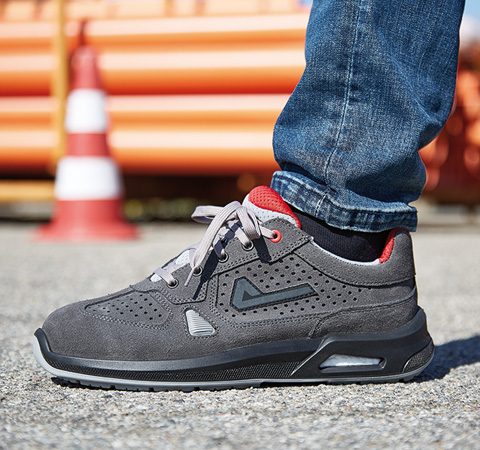
Having teamed up with Aimont, a safety shoe manufacturer, Supertouch is now providing its customers with a range of footwear to meet the specific needs of the of the construction industry. Follow our six steps to ensure you get a shoe fit for purpose.